
A UCL (Ulnar Collateral Ligament) injury, commonly known as Skier’s Thumb, can severely affect everyday activities such as turning a key, opening a jar, and holding simple objects due to pain, swelling, and instability in the thumb joint. Many patients seek treatment after symptoms begin interfering with their grip strength and quality of life.
Patient Success Stories
Hear from patients who experienced relief from Skier’s Thumb symptoms after treatment with Dr. Badia and his team.
Understanding Skier’s Thumb (UCL Injury)
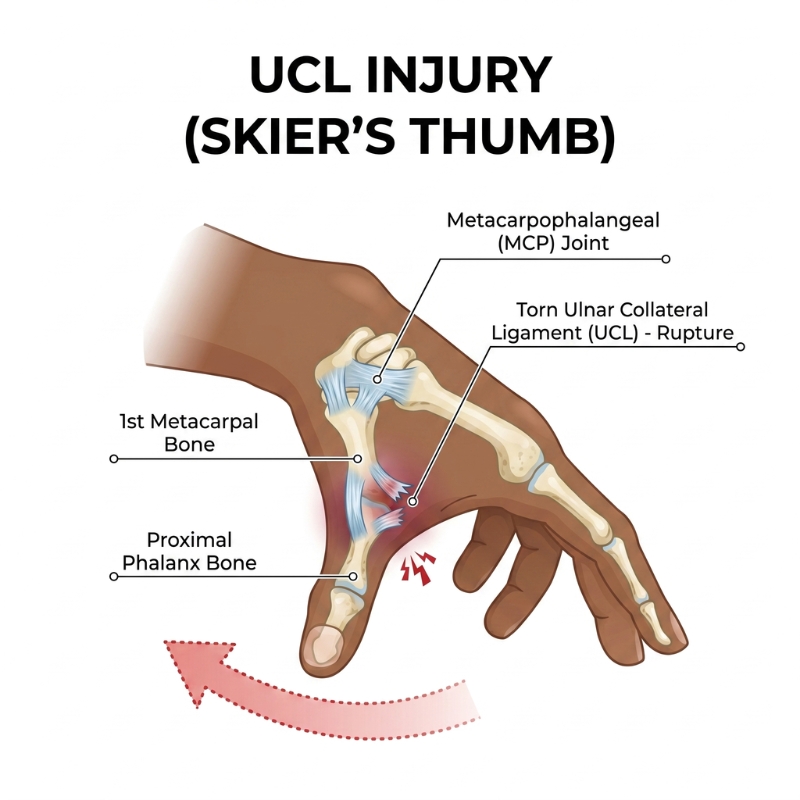
Skier’s Thumb is a common orthopedic condition that involves a partial or complete rupture of the Ulnar Collateral Ligament (UCL) at the base of the thumb. This ligament is crucial for stabilizing the thumb, especially when grasping or pinching objects.
This injury typically occurs when the thumb is forcefully bent away from the hand (hyperabduction). A classic example is falling onto an outstretched hand while holding a ski pole, or suffering a sudden impact during sports. Early diagnosis and proper treatment are important to prevent permanent joint instability and restore full hand function.
What is Skier’s Thumb?
Skier’s Thumb simply means that the ligament on the inner side of the thumb has been damaged or torn. Depending on the force of the impact, this tear can be partial or complete.
When this essential ligament is compromised, the joint loses its structural support. This instability makes it incredibly difficult to perform basic tasks and leads to the symptoms of a UCL Injury.
The symptoms most often reported with Skier’s Thumb are pain, swelling, and bruising at the base of the thumb. There is often a noticeable “looseness” in the joint, and patients frequently experience a significant loss of pinch and grip strength. If left untreated, chronic instability can lead to early-onset arthritis.
Common Symptoms
Symptoms of a UCL injury typically appear immediately following an acute trauma. The severity of the symptoms often directly correlates with whether the ligament is partially or completely torn.
Pain and Swelling
Patients commonly experience immediate, sharp pain and noticeable swelling directly at the base of the thumb following the injury.
Bruising
Discoloration and bruising often develop around the base of the thumb and can extend down toward the palm or wrist.
Joint Instability
The thumb joint frequently feels “loose” or unstable, shifting abnormally when pressure is applied.
Weak Pinch and Grip
Patients notice significant difficulty or weakness when trying to perform a power pinch or grip, making tasks like turning a key nearly impossible.
Causes and Risk Factors
A UCL injury is almost always the result of a sudden, forceful impact that bends the thumb backward or sideways, away from the rest of the hand.
Common causes and risk factors include:
- Falling onto an outstretched hand
- Skiing accidents (falling while holding a ski pole)
- Sports-related injuries and collisions
- Forceful backward or sideways hyperabduction
- Motor vehicle or bicycle accidents
While skiers are highly susceptible due to the mechanics of holding a pole during a fall, anyone experiencing an acute hyperabduction of the thumb is at risk for this injury.
How It Is Diagnosed
Diagnosis begins with a detailed medical history and a physical examination. Dr. Badia evaluates the stability of the thumb joint, the location of the pain, and checks for any “looseness” to determine the extent of the ligament damage.
Depending on the case, additional studies may include:
- X-rays to check for avulsion fractures (when the ligament pulls a piece of bone away)
- Ultrasound imaging to view the soft tissue
- MRI in selected cases to confirm if the rupture is partial or complete
An accurate diagnosis is crucial because a completely torn UCL will not heal on its own and requires prompt medical attention to prevent chronic instability.
Treatment Options for Skier’s Thumb
Treatment depends entirely on whether the Ulnar Collateral Ligament is partially torn (sprained) or completely ruptured. Timely intervention ensures the best optimal outcomes for the patient.
Non-Surgical Treatment
For mild to moderate cases involving a partial tear where the joint remains stable, conservative treatment is often effective:
- Immobilization with a splint or cast
- Resting and icing the affected area
- Physical therapy to regain strength and range of motion
These approaches aim to protect the ligament while it heals naturally over a period of several weeks.
Specialized Orthopedic Care
For complex injuries, collaborating with a highly skilled specialist is vital. Dr. Alejandro Badia brings immense expertise in hand and upper extremity orthopedic surgery.
His experience and skill in treating orthopedic problems of the hand make him an excellent choice for managing severe UCL injuries, ensuring both patients and assisting healthcare professionals achieve the best possible care.
Surgical Treatment
In severe cases where the ligament is completely torn, or pulled away with a piece of bone, surgery is required to repair or reconstruct the torn ligament.
Surgical repair restores the anatomical stability of the thumb, completely resolving the joint “looseness.” Following surgery, a guided physical therapy program is essential to regain full function and grip strength.
Articles About Skier’s Thumb
Explore educational articles, patient resources, recovery insights, and medical information related to UCL Injuries and Skier’s Thumb. These resources are designed to help patients better understand symptoms, treatment options, rehabilitation processes, and advances in hand surgery.