By LUISA AGUERO
FACED WITH A GRIM DIAGNOSIS, THERE IS HOPE THAT ALLOWS PATIENTS SENTENCED TO THE AMPUTATION OF AN UPPER EXTREMITY TO RECOVER IT AND ENJOY A NORMAL LIFE.
Have you ever stopped to look at your hands and think about how useful and functional they are for the activities you do every day? Well, believe it or not, today, many people cannot look at them because they have lost them partially or totally in traffic, work, or sports accidents, and find themselves unable to live the life they used to have. But the opportunity to improve lies in the advances in arthroscopy related to hand and wrist injuries that were presented in Honduras by Dr. Alejandro Badia, a renowned hand and upper extremity surgeon from Miami, United States. Some of these injuries are carpal tunnel syndrome, fractures, sports injuries of the wrist and hand, and joint replacements.
The specialist, who also studied physiology at Cornell University and earned his medical degree from New York University, also explained the benefits of arthroscopy, which include less postoperative pain compared to open (traditional) surgery, as well as a reduced risk of complications and scarring.
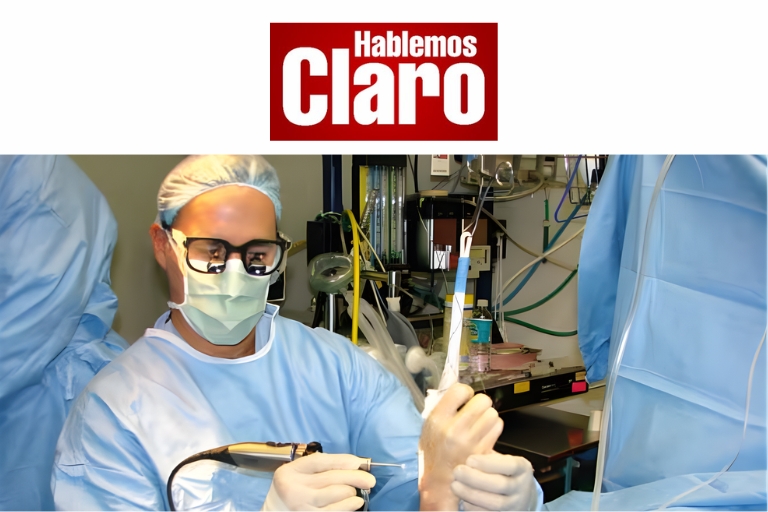
Arthroscopy of the hand and upper extremity is a minimally invasive technique in which a tiny optical fiber is used as a camera to look inside the joints. But arthroscopy simply means observing a joint using an instrument that not only allows for diagnosing a problem, but often leads to a conclusion about what definitive treatment would be best for the patient, the specialist noted during a presentation in San Pedro Sula.
“What a pleasure to travel to beautiful San Pedro Sula and share my knowledge with colleagues, as well as reconnect with local patients I have treated in Miami,” stated Badia, founder of Badia Hand to Shoulder Center and OrthoNOW. “It is a pleasure to offer my patients minimally invasive treatments with less pain and a fast, healthy recovery,” he said.
The Focus
The use of wrist arthroscopy has been useful in sports injuries, commonly from tennis and golf, and has been crucial to the advancements discussed by the International Society for Sport Traumatology of the Hand. This entity is aimed at educating athletes, trainers, and Sports Medicine colleagues about the vital role that hand surgery, including wrist arthroscopy, plays in the functional recovery of upper extremity injuries in athletes.
Shoulder arthroscopy can also be performed on young patients who suffer significant injuries related to vehicles, sports, or even work. Rehabilitation after shoulder arthroscopy remains critical across all groups. Dr. Badia uses the latest ARP (Accelerated Recovery Performance) Wave therapy technology to minimize postoperative pain, limiting atrophy and simultaneously accelerating the recovery process.
When referring to hand surgery, the specialist is talking about a minimally invasive procedure where even small joints have come to be managed through arthroscopy, something in which he is a pioneer, especially in techniques at the base of the thumb and the small joints of the hand. The practice of hand surgery worldwide is excellent. Currently, thanks to medical conferences and the internet, doctors from all over the world are continually discussing cases and exchanging opinions. The only problem is that in some countries there is no access to the highest technology due to the country’s limited resources.
Alejandro Badia specialized in the field of hand surgery because when he was eight years old, he went with his grandmother to see a hand surgeon in New York since she suffered from rheumatoid arthritis. At that moment, he became very interested in the concept and always kept it in mind while studying medicine. Today, his profession is something he is very proud of because he has been able to change the lives of many people. The feeling that inspires him professionally is being able to return that worker or that athlete to their sport or daily life. Hand surgery is very important because ultimately we all work with our hands and we must get the best result; that is why the surgeon in that area holds a special place in the field of orthopedics, says Badia, who was named one of the top 45 hand and upper extremity surgeons in the United States by the Becker Orthopedic & Spine Review in 2011.
A Therapy
ARP Wave Neuro Therapy is a treatment that works based on the origin of the joint problem, tears, sprains, fractures, or repetitive task injuries that are caused by muscles not adequately absorbing force. This energy is transferred to tissue not meant to accept the force. “We find the muscles that are unable to do their job and try to eliminate the cause. Most of the time, this will resolve the symptom of pain or weakness. We don’t treat the specific bone fracture, joint problem, or tear, but we treat the muscles so they can do their job,” he said. ARP Wave is an acronym for Accelerated Recovery Performance, a system comprised of technology and protocols created by Denis Thompson, founder of the ARP Wave system.
The Outlook
The wrist frequently suffers injuries in different sports activities that can range from overuse syndromes to fractures. In most cases, the problem is that the patient does not go to a doctor specializing in the wrist, and a diagnosis can be difficult to obtain. Therefore, when evaluating patients with wrist pain, it is important to establish whether it is chronic or acute, its location, if it is exacerbated by some type of manual activity, and if it can be reproduced with special maneuvers during the physical examination.
Usually, these injuries present as a result of a fall with an outstretched hand, producing fractures of the distal radius, scaphoid, or ligament tears. These injuries are common in young adults whose wrists do not suffer from osteoarthritis or degenerative problems, and they produce soft tissue alterations due to the mechanism of the injury. Once the athlete has been injured, they must be properly immobilized until evaluated by a hand surgeon.
It is important to mention that the approach to scaphoid fractures is different when they occur in a high-performance athlete. From that perspective, the specialist prefers, in this type of injury, to perform a percutaneous fixation with a tapered compression screw (Acutrak), which provides complete stability and the possibility of early rehabilitation with a quick return to prior sports activity.
Hook of the hamate fractures are usually difficult to diagnose. Their incidence in athletes is 2 to 4%. During the physical exam, it is possible to find deep tenderness to palpation in the hypothenar eminence. The best methods for radiographic evaluation are the carpal tunnel view and a computed axial tomography (CT) scan. Non-displaced fractures can be treated conservatively, but for displaced ones, he prefers excision of the hook.
Distal radius fractures must be treated surgically, and in these young patients, regardless of the displacement of the distal fragment and joint involvement, his preference is fixed-angle fixation via a volar approach.
Lunotriquetral (L-T) ligament injuries occur following a fall with a rotational component. They are one of the differential diagnoses for ulnar-sided pain and must be differentiated from a triangular fibrocartilage injury. These last two can occur isolated or concurrently. In an L-T ligament tear, it is common to find tenderness to palpation in the interval, with ulnar deviation and instability using the ballottement test.
Arthroscopic diagnosis should be performed from the radiocarpal and midcarpal portals; a probe is used to verify the presence of instability and determine if there is a partial or complete tear of the interosseous ligament. If the injury is partial, debridement of the ligament with protective immobilization will be sufficient; however, when there is a complete rupture, debridement of the interosseous ligament must be combined with percutaneous fixation of the joint with two Kirschner wires for a period of no less than six weeks. The same treatment protocol is used in those patients presenting with scapholunate ligament injuries.
Perhaps the most frequent sports ligament injury of the wrist is to the triangular fibrocartilage. Once the clinical diagnosis is obtained through a detailed physical examination showing pain upon pressure on the ulnar side and resisted pronosupination, the next step is to perform a diagnostic/therapeutic arthroscopy. In cases of central tears without loss of the trampoline effect, proper management is debridement of the lesion followed by immobilization for one week before restarting range of motion.